
THE SERPENT
With its distinctive persona and dangerous charm, the serpent has long captured the imagination of man, and has been cast as a central figure in the myths and folklore of virtually every culture in the world.
It was a key motif for countless civilizations, from the Aztecs to the Egyptians, who believed that the snake’s continuous shedding of its skin was a symbol of fertility, regeneration, resurrection and immortality. In Egyptian mythology, the goddess of maternity and fertility, Isis, is closely connected to the snake. According to legend, it was a serpent that gave her the power to heal.
In Greek mythology, the snake evoked life, and its image was used to represent healing, death and rebirth. Its association with immortality is derived from its connection to the Earth and the waters that flowed from it, and thus it came to represent the generative forces harbored by the earth and the underworld. The snake’s capacity for transformation is also at the heart of the ouroboros symbol. Characterized by a snake or dragon biting its tail, this ancient icon forms a never-ending circle, and appears time and again throughout history — a representation of the universal energy that is forever being consumed and renewed, and the cyclical nature of the universe. Its oldest representation dates back to an Egyptian funerary text, called The Enigmatic Book of the Netherworld, where the ouroboros appears as a manifestation of the serpent god Mehen who protects the boat of Ra, the god of the sun, during its daily trip from sunrise to sunset. It is also common to see the ouroboros framing magical writings as a symbol of the god Aion, a gnostic expression of the totality of time, space and the primordial ocean. Finally, in the alchemic tradition, the ouroboros represented the cyclic sequence of distillations and condensations necessary to purify and perfect the “first matter” to obtain the philosopher’s stone, which was said to give its possessor omniscience, immortality and the power to transform simple metals into gold.
The snake conjuring a divine ancestry is also a key facet of the legendary figure of Alexander the Great, who claimed to have fathered by Zeus, the king of the gods, and is said to have turned into a snake to seduce his mother, the Epirot princess Olympias.
These beliefs are especially prevalent in the Hellenic cults of Dionysus and Asclepius. In ancient Greece, the latter was venerated as the god of medicine, and was often represented holding a rod around which were coiled two serpents, which were seen as sacred creatures whose molting symbolized rebirth, fertility, healing and the forces released from the depths of the earth. In fact, the Greeks believed that one had only to sleep in a sanctuary dedicated to Asclepius to overcome any illness. Shrines to these gods were erected in areas of special natural importance that were closely associated with earthly powers. In the temples dedicated to Asclepius, the afflicted underwent special ceremonial rituals and then slept at the foot of a statue of the god, who was thought to visit the sick person during the night and help them become cured. The cult of Asclepius migrated from Greece to Italy, to Tiberina Island in Rome. This site was dedicated to Asclepius when a serpent that had been consecrated to the god and brought to Rome to fend off the plague of 293 BC escaped overboard from the ship that carried it, swam the Tiber until reaching the island, and then disappeared. At the site of its disappearance, a temple was built and inaugurated in 289 BC.
The figure of the snake appears not only in ancient myths and legends, but also in the works of numerous authors, poets and artists of more recent centuries, further evidence that this archetype continues to be an extremely powerful one.
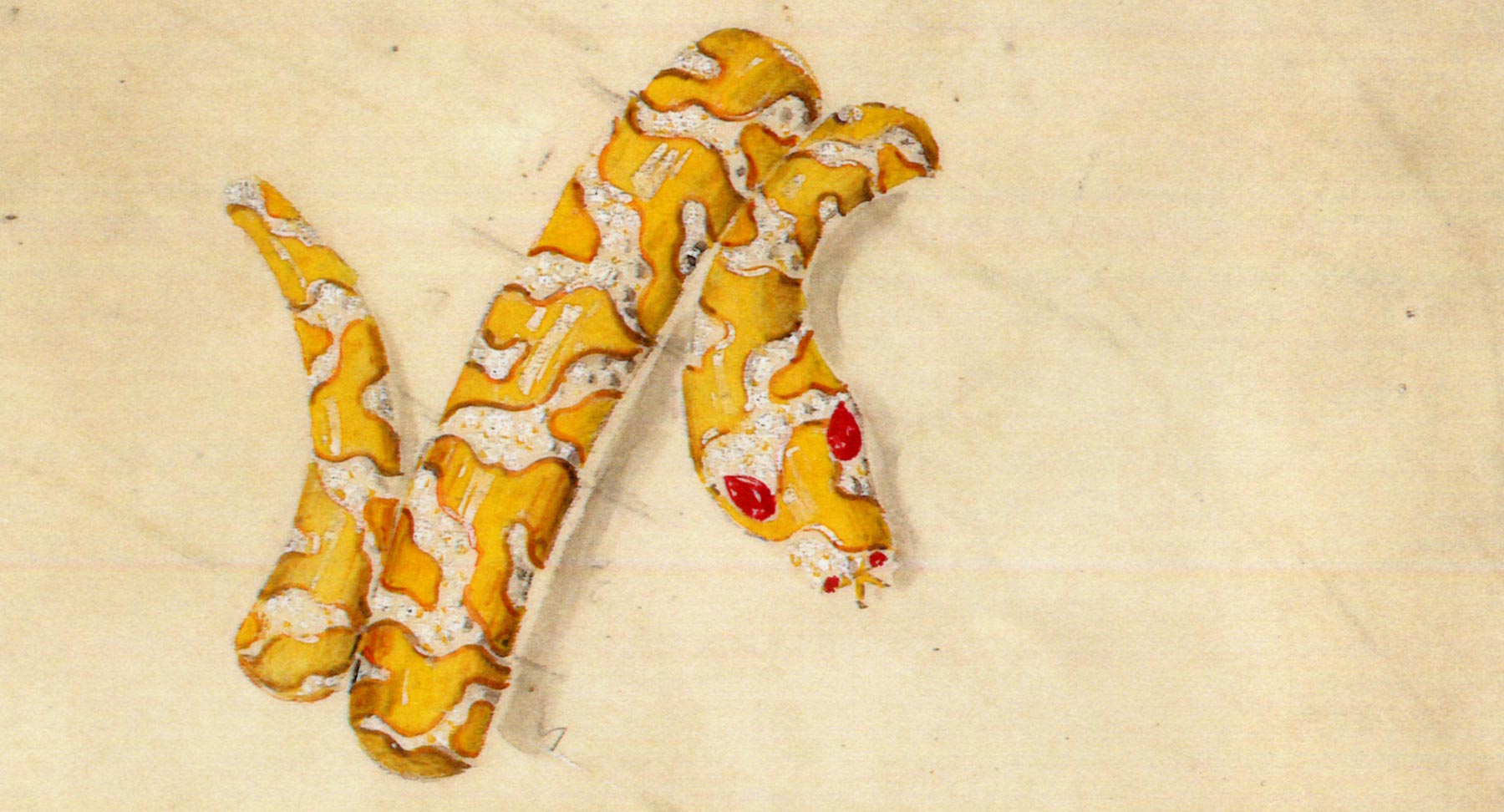
The serpent motif is also a constant presence in the history of jewelry design, serving both ornamental and propitiatory functions.
The reptile thus undergoes a catharsis and turns — as only it can do — into a lucky talisman or an eloquent warning to protect sacred places. The first legend is about Heracles, the demi-god born from the adulterous union between Zeus and Alcmena, wife of Anfitrione, king of Tirinto. Taking advantage of the absence of the king, Zeus seduced Alcmena, with whom he was madly in love. From their union, the demi-god Heracles was born but this caused the unavoidable jealousy of the goddess Hera, wife of Zeus, who, in revenge, sent two snakes into the cradle to kill the child. Heracles killed them instead and, following this legend, from the middle of the fourth century BCE, two intertwined snakes thus came to form the “knot of Heracles” symbol that is often seen as a lucky charm on bracelets. The snake motif in jewellery also shows the influence of Egypt on Ancient Rome: by the first half of the first century BCE, exquisite serpentine artefacts from Egypt had made their way into Rome. The arrival of Cleopatra in Rome in 46 BCE took this fascination even deeper; with her rule, the serpent became inextricably associated with wealth and opulence.
Jewelry from the time includes spiraling gold bracelets with scales, and eyes made from gemstones or powdered glass paste.
Because of its connection to the devil, the image of the serpent disappeared almost completely from the jewelry of medieval Europe. It was not until the mid-19th century that it reappeared, particularly in bracelets and necklaces made with flexible gold chains, and often encrusted with turquoise. From around 1890, an enameled version of the serpent motif became a recurring theme in the jewelry of the Art Nouveau movement, which drew from the past, particularly the Renaissance, to reinvigorate one of history’s most noble and enduring icons.
THE SNAKE
IN THE BVLGARI
TRADITION
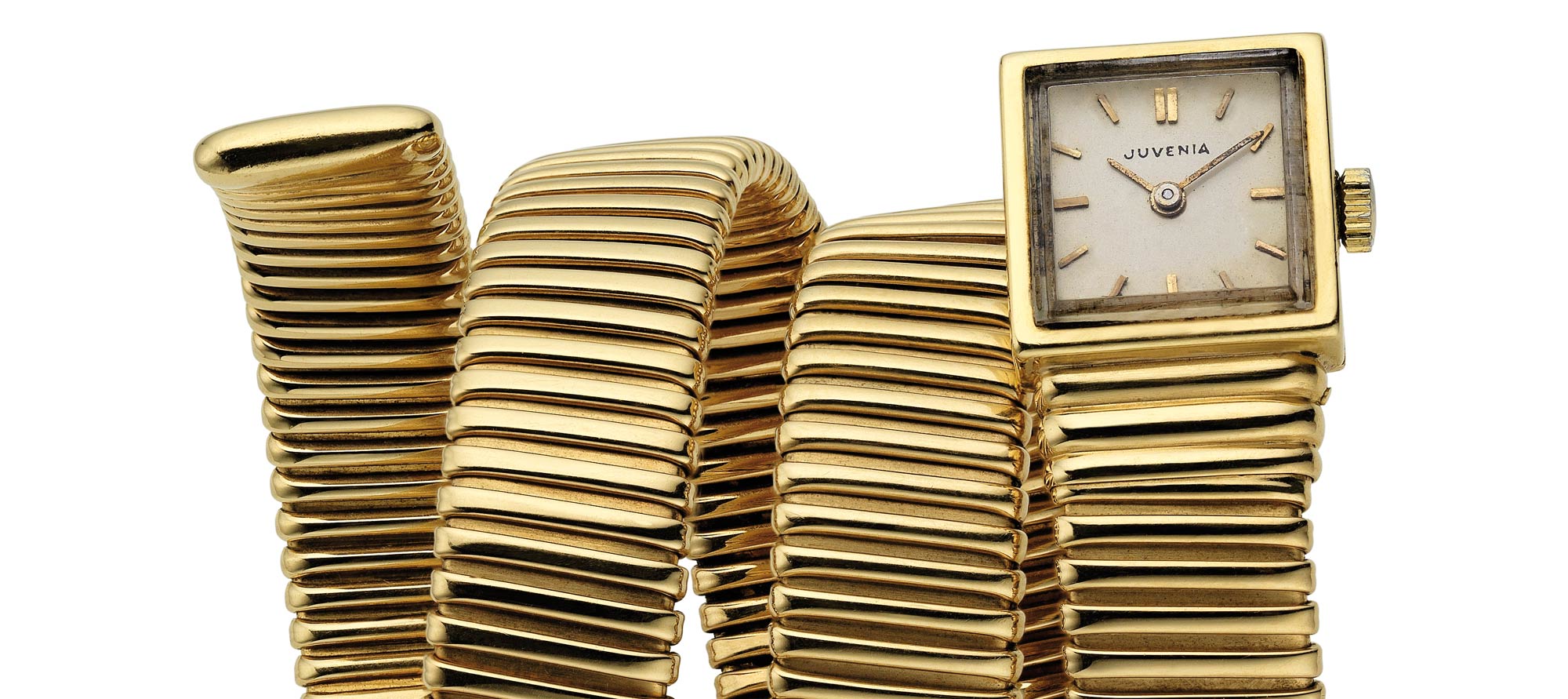
The serpentiform bracelet-watches of Bvlgari, characterized by a dial set into a head studded with gems and gold coils that wrap around the wrist, have become a landmark in the history of jewelry, which in turn intersects with that of the company itself.
The origins of the early Bvlgari snake-shaped bracelet-watches is closely linked to the use of Bvlgari’s tubogas technique. The first examples date back to the late 1940s and were in the shape of a highly stylized serpent with coils realized either in the typical tubogas or in gold mesh that wrapped around the wrist. The watch-case and dial, usually square or rectangular, were placed at one end to evoke the serpent’s head. The elegant sobriety of these creations was an instant success in the Post War years, when full economic resurgence in Europe was yet to come and showy pieces were neither suitable nor affordable. As such, they proved to be refined accessories with a function, in tune with womens’desire to appeal with distinctive ornaments despite the circumstantial budgetary constraints.
In the years that followed, this kind of watch evolved into increasingly varied and interesting versions that explored every possible shape of case and dial: round, square, octagonal, pear- and cushion-shaped were all used, both with or without diamonds bezels. The case was positioned at the end or at the centre of a bracelet in tubogas coil, which was itself realized in every possible variation: steel, blackened steel or a combination of gold and steel. The movements were always of the highest quality: Audemars Piguet, Jaeger LeCoultre, Movado and Vacheron Constantin usually customized their movements for Bvlgari, the logo of movements’ maker appearing alongside the logo on the dial.
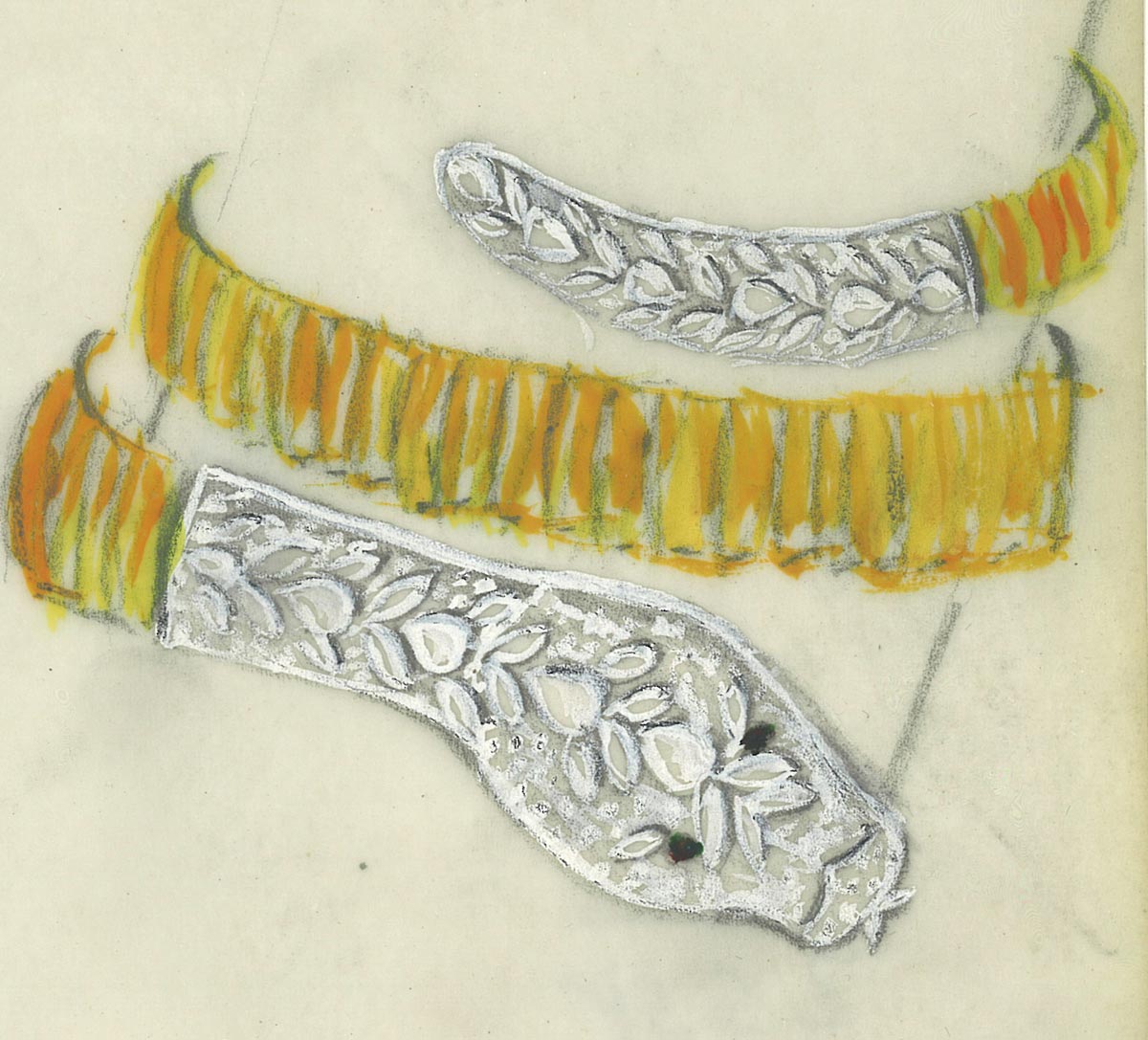
The second half of 1950s saw the first models where the serpent was rendered in a more realistic manner, asserting the connection to ancient tradition more explicitly. In Bvlgari’s serpent watches from this period, the watch case was concealed in the snake’s head and the dial lay under a hinged cover on the upper and central part of the head. Numerous elements of especially elaborate manufacture formed the body: every scale was crafted by hand from sheet gold and attached to each other by soldered gold pivots or, in the case of the enameled versions, screwed together. Running through the core was a spring made of white gold that ensured perfect flexibility.
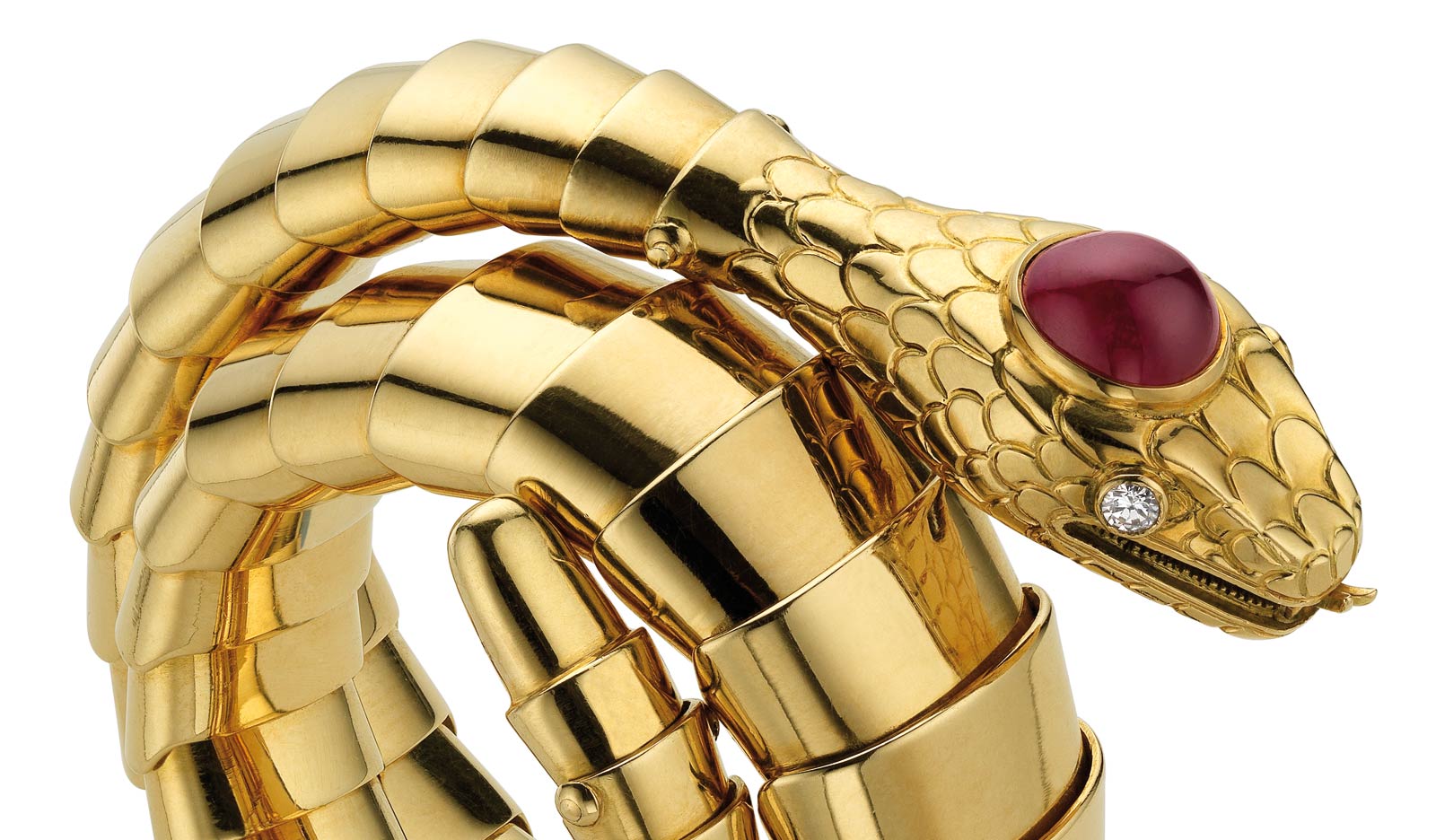
The first animalier models were realized exclusively in yellow gold with the heads and tails in platinum and decorated with diamonds. Elizabeth Taylor’s watch, immortalized on the actress’s wrist in a photograph taken on the Cleopatra set in 1962, constitutes a magnificent example. The serpent’s head is in diamond pavé with emerald eyes and is embellished with a crest composed of marquise-shaped diamonds. Naturally, numerous variations were produced in the years that followed, including some without the watch itself. The body was always in gold, but the little scales of the early models were transformed into larger ones, adorned with polygonal diamond decorations or multicolor enamel in the most varied and flamboyant of combinations including turquoise and white, red and yellow, green, red, black and pale blue, and so forth. In these variants, an average of two hundred hours of work were needed, with the “Harlequin” model, so called because it featured four colors, being more expensive to make as it required each enamel pigment to be fired separately. The enameling procedure of the polygonal cavities morphing the scales was a process that required a long and patient preparation lasting three days: the grinding of the colored glass, the decanting of the powders, washing, application, firing, cooling and finishing. Hardstones such as coral, turquoise, lapis lazuli or jade were also successfully adopted to render the scales, always with very impactful chromatic combinations. To complement such an intricate livery, different stones were used to simulate the serpent’s eye. Yellow or colorless diamonds, rubies, sapphires, and emeralds that were pear-shaped, marquise-shaped or circular were all used.
These vibrant animalier versions reflected the social and customs trends of the 1960s, when women showed a more self confident attitude, deeply rethinking their role in society and challenging conventions. Bold and charismatic, the Serpenti creations expressed a female attitude in charge of the laws that ruled seduction, making fun of the traditional role of the “sinful woman”. The Serpenti creations wrapped around the wrist immediately conveyed their belonging to the charismatic woman who wore them.
Diana Vreeland, the arbiter of New York fashion, loved to wear her customized Bvlgari snake belt doubled up as a necklace. Vreeland was so fascinated by the alluring power of snakes that in a memo of 1968 addressed to her editorial staff she wrote” Don’t forget the serpent…the serpent should be on every finger and all wrists and all everywhere”. Not by chance, fashion magazines started to feature shootings by masters of photography like Gian Paolo Barbieri, Franco Rubartelli or Bert Stern with models wearing Bvlgari Serpenti creations in self assured poses. Not by chance, an iconic Bvlgari advertising campaign from the 1970s features a big “B” wrapped by numerous variants of Serpenti models, thus further affirming the relevance of this powerful motif in the Brand’s creative universe. Beyond the bracelet-watches, over the years the Bvlgari Serpenti line has been enriched with necklaces, rings, belts, gold clutches, and, with the development of the Maison’s range of accessories in the Nineties, sunglasses and bags in precious leathers. The motif of the snake has thus expressed and continues to express the multiform creativity of the Maison, at the same time as encapsulating its constant stylistic evolution. A centenary metaphor of transformation and rebirth, there is no better animal to encapsulate the mystery of time.